A Temple to Nature

I’m in London now. On Monday I fly back to Australia. A wonderful trip, but it’s time to go home. After six weeks away, I’m missing my family and animals more than I expected to. Now I can’t wait to return and enjoy the release of Brumby’s Run in a few weeks time. Advance copies are waiting at home, and I haven’t even seen them yet!

I’ve been to all sorts of amazing places since leaving the Tyrone Guthrie Centre: Dublin, Edinburgh, Loch Ness, the Isle of Skye, Stonehenge, Bath and the historic village of Lacock, entirely owned by the National Trust. Lacock is the place where Harry Potter was largely filmed. I even had the dubious experience of being robbed on the Tube.  But my blog tour of Ireland and the United Kingdom wouldn’t be complete without a visit to London’s 125 year old Natural History Museum.

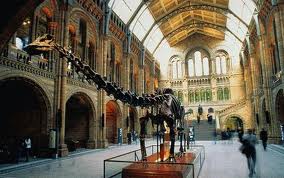
The museum was purpose-built (I love that!) and is one of the finest Victorian buildings in England. Behind its magnificent Romanesque facade lies perhaps the world’s most important natural history collection. In the grand space of the Central Hall stands a full size replica of a 150-million-year-old Diplodocus skeleton. It has stood there since 1905 and is a full 26 metres long. Each exhibition is more amazing than the last: plants, birds, mammals, fossils, the earth hall, the wildlife garden, the Darwin centre … they’re all fascinating.

My favourite display was the exhibit of marine fossils. It features the first ichthyosaur ever found, discovered by blaze-trailing fossil finder, Mary Anning. There are also two skeletons of pregnant ichthyosaurs: in one case, three little foetus skeletons are visible between the mother’s ribs and in the second, the baby is forever frozen in the birthing process, with its tiny tail protruding from its mother’s body. Only a small fraction of the museum’s collection is on display. Behind the scenes, lie kilometre after kilometre of stored specimens. It makes me smile just to think such places exist in our world.

Cairngorms National Park

On my way to the Isle of Skye yesterday, I passed through Cairngorms National park. It contains Britain’s highest and most massive mountain range, and its biggest native forests. Everywhere you look, there are spectacular rivers and lochs, heather-covered moorlands and dramatic peaks. The park is a stronghold for wildlife.

The Cairngorms National Park is in north-east Scotland and was established in 2003. It covers an area of 4,528 km². The Highland Wildlife Park, within Cairngorms’ boundaries, looked like the only chance I might get to see some of Scotland’s most interesting animals. Like Ireland, Scotland has a formidable history of extinctions. Only a tiny fraction of original native forest cover remains. Eurasian Lynx lived here until 1,500 years ago. Brown bears became extinct in the 9th or 10th century and elk survived until about 1300. Wild boar and wild ox (Urus) died out by the  the 15th century. Auroch, huge cattle with sweeping horns which once roamed the forests of Europe and Scotland, have not been seen for nearly 400 year. The last known wolf was shot in Invernessshire in 1743.

Attempts at rewilding are being made. Scottish Natural Heritage have re-introduced the European Beaver using Norwegian stock. The species was found in the Highlands until the 15th century.  Wild Boar have come back to a large fenced area of the Dundreggan Estate in Glenmoriston. Apparently the owner of the Alladale estate north of Inverness wants to add wolves to a wilderness reserve, the first of its kind in Britain. For now I’ll have to settle for the wonderful animals on show at the Highland Wildlife Park. Rare species like Wildcats, Pine Martens and Capercaillies. Will wild individuals even exist in a few decade’s time? Scottish conservationists are doing their best. I take my hat off to them.

Irish Wildlife – Past and Present

European RobinThe Tyrone Guthrie Centre in Annaghmakerrig is set on a five hundred acre estate, consisting mainly of coniferous plantation forest (Sitka Spruce) but with some pasture and remnant native woodland as well. There are white swans on the lake (I’m used to black ones!) and swathes of bluebells as far as the eye can see. The wood is very dark, like something out of Macbeth. I’ve seen Red Deer on its edge, but unfortunately have yet to see a badger or pine marten.

I’ve been intrigued to see what wildlife lives here. Birds abound. Species spotted so far include: Chaffinch, Goldfinch, Greenfinch, Jackdaw, Rook, Magpie, Common Swift, Grey Heron, Mute Swan, Song Thrush, European Robin (Robin Redbreast) and what I think was a Eurasian Kestrel. A little thrush is singing in a tree outside my window as I write this post, and it rivals Australia’s Butcher Bird for the beauty of its song. I haven’t mentioned birds which I commonly see back home as introduced species, such as blackbirds and sparrows. The very first bird I saw at Dublin Airport was disturbingly an Indian Myna, a destructive invasive species worldwide, but thankfully they don’t seem to have reached this far into the Irish countryside.

As I wander about this beautiful estate, watching for wildlife, I am aware of what is missing, almost as much as what is present. Once upon a time this was a vast oak woodland. Grey wolves and brown bears roamed, along with elk, beavers and lynx. Six bird of prey species have gone extinct here, although attempts are being made to reintroduce the Golden Eagle, White-tailed Eagle and Red Kite into nearby national parks. Only twenty-six land mammal species were ever native to Ireland, because it was isolated from the European mainland by rising sea levels after the last ice age. Many of those that have survived are now under threat from invasive species, habitat loss and illegal hunting. Wherever I go in the world, the presence of our lost creatures seems very real to me. Maybe ghosts haunt more than houses.

Bella – A Southern Beauty

I’m dedicating my new novel, Brumby’s Run, to the wonderful Brumby welfare organisations around Australia. These groups rescue Brumbies, train them and rehome them. They campaign to improve the management of Brumbies in the wild. They work hard to raise the profile of Brumbies as part of our heritage, and also as wonderful riding and companion horses.

I’d like to tell the story of one such Brumby, Southern Belle, affectionately known as Bella. Check out the marking on her belly that resembles the Southern Cross. It doesn’t get more Aussie than that for a Brumby!  Bella was amongst a group of Brumbies trapped on the 18th of August 2011 in Kosciuszko National Park. They were transported to Gundagai and within 24 hours of capture, were collected  by the Hunter Valley Brumby Association. Many Brumbies are not so lucky, and end up at the slaughter-house instead.

Bella and KathBella found the capture and transport very stressful – at 13 months of age, she had lost everything – her home, her mother and all she knew. Bella’s world had crashed around her. Even after days of handling, Bella still stood in the corner of the yard, head down and trembling from head to toe, completely terrified. It was heart breaking for HVBA President, Kath Massey, to see. People often chase, harass and even shoot Brumbies. There is no way of knowing until horses are handled, which ones have had a very negative experience with people before being trapped.

In time Bella began to develop more confidence in herself and in her surroundings – but only with Kath, who she looked to as the “lead mare” in teaching her about her new domestic world. Bella began to trust Kath – to play and explore and run around with her tail up. It was lovely to see her genuinely happy. Everyone on the HVBA Committee agreed that Bella would be devastated if she was to lose her new home, and she has now been adopted by Kath.

It is hoped that one day Bella will be out in public, showcasing how beautiful Kosciuszko Brumbies are and campaigning to better their future – and with the bond that is now firmly cemented between Southern Belle and her new owner, anything is possible. I’ll keep you updated on their progress!

Coincidentally, my friend Margareta Osborn has just published her debut novel, titled Bella’s Run. A fifth generation farmer, Margareta grew up on her family’s historic dairy farm in East GippslandBella’s Run is set partly in Victoria’s rugged high country and is a great read. The story even mentions the odd Brumby or two!

The Diamond Weevil

When I went out to check the water troughs this morning, I was delighted to find a Diamond Weevil (Chrysolopus spectabilis) perched on a Silver Wattle. This gorgeous bug is also commonly known as the Botany Bay Diamond Weevil or the Sapphire Weevil. I like weevils. They look like tiny, humble elephants, with their lumbering gait and long snouts.

Weevils are the most successful and abundant family of creatures on earth. There are estimated to be over 10,000 species in Australia alone, with only 5,000 having been named. The Diamond Weevil has a proud history. A specimen was collected by Joseph Banks at Botany Bay during Cook’s voyage of discovery in 1770. It was the very first Australian insect to be scientifically described.


Diamond Weevils are specialist feeders, living only on a few species of wattle. Females lay eggs inside the stems. They hatch into grubs which feed on roots and then undergo metamorphosis. The adults or imagines (what a lovely name!) emerge during spring in all their brilliance. They are black, but beautifully patterned with palest, iridescent green. Put a Diamond Weevil on your hand, and it it so bright and shiny, one wonders how it ever escapes predators. But back on on the feathery, silver-green foliage of the Silver Wattle, it is surprisingly hard to see. The map above shows the distribution of the Diamond Weevil on mainland Australia.

The Lucky Country

The 13th annual Sustainable Living Festival in Melbourne, brings together individuals, communities, organisations and businesses who share a vision for a sustainable world. The festival showcases and celebrates the many aspects and benefits of this lifestyle. It is Australia’s largest and oldest sustainability festival.

Sustainable living means living within the Earth’s limits. It means making consumer choices that are mindful of finite resources. It means living more simply – taking care of nature so nature can take care of us. The ultimate aim is to meet our needs without compromising the ability of future generations to meet theirs.

The Festival’s Big Weekend event at Federation Square in the heart of Melbourne will celebrate the very best examples of ecological and social sustainability. The event will fuse interactive workshops, talks, demonstrations, artworks, exhibits, films and live performances.

I am a member of the Environmental Farmers Network, and John Pettigrew, our spokesperson on Murray Darling matters, will be speaking at the festival this Sunday 19th February at Federation Square.  John is a passionate environmentalist who believes in a scientific approach to saving the basin. A retired orchardist who lives on the banks of Goulburn River just north of Shepparton, he is under no illusion when it comes to the importance of the river to his community. “It is our life support here in the Goulburn Valley as it is (with other rivers) right across the Murray-Darling Basin.”   http://www.environmentalfarmersnetwork.net.au/

If you are in Melbourne this weekend, why not come along and hear what John and the other festival guests have to say?

The Tarkine

It’s a beautiful and dramatic region, with wild rivers, deep gorges and vast rainforests. Here, some of the tallest and oldest trees in the world are being logged for woodchips — irreplaceable virgin forests turned into toilet paper.

The second-largest temperate rainforest in the world is right here in Australia. It’s a safe haven for one of the last wild populations of Tasmanian Devils free of the tumor disease that is threatening the species with extinction.

Tasmania’s Tarkine is Australia’s only wilderness area dominated by rainforest. It is 70% of the total forest cover. More than 90% of this is old-growth forest.

Temperate rainforest is the rarest of rainforests — existing only in fragments in New Zealand, Chile, western Canada and the US. It is more highly threatened than tropical and subtropical rainforests. The Tarkine contains the largest continuous tract of temperate rainforest in Australia, and the second largest in the world.

The Tarkine contains 60 species of flora and fauna which are listed as either threatened or endangered, including the spotted tail quoll, the eastern barred bandicoot and the grey and goshawk bandicoots.

Rainforest timbers have little value as timber trees. Current estimates put the amount of veneer and sawlog taken out of rainforest coupes at less than 10%, the rest going to woodchips. However, the rich basalt soils of the Tarkine make this a very attractive plantation region.

Rainforest is often clearfelled, then burnt and replanted with more commercially viable species. This process of converting unprofitable rainforest is the single biggest cause of species extinction in Australia. Logging pristine rainforest on public land has been banned in all mainland states.

Environment Minister Tony Burke has let the Tarkine’s emergency heritage status expire, and now the mining companies are circling. Let’s protect this treasure before it’s too late!

Indian Myna Birds

Indian Mynas are one of the most invasive animal species in the world. Introduced into Australia in the late 1860s to control insects in market gardens, they have now spread to most of coastal Australia and New Zealand. Mynas are a serious environmental threat to native wildlife, taking over nesting hollows, evicting birds and small mammals, and preying on nestlings.

I admire these adaptable little birds, I really do. Their success is testament to their intelligence and devotion to their young. They are also great songbirds and mimics. Nevertheless, I am a member of a landcare group that routinely destroys these birds. I have personally trapped sixty six mynas at Pilyara in just three years, handing them over to be euthanased.

This makes me very sad. Each time a group is consigned to be gassed, I say a little prayer and apologise to them. After all, this isn’t their fault. We brought them here.They are innocent, just surviving – doing what mynas do, and making a pretty fair fist of it.  And that, of course, is the problem. For one myna becomes ten in just three years. That means my sixty six birds would have become six hundred and sixty by now. Local wildlife could never cope with such an onslaught. So I continue my involvement with the program, and monitor the skies for mynas. I just never forget who the true culprits are.

The Pink Hyacinth Orchid

Tall spikes of Pink Hyacinth Orchid (Dipodium roseum) are blooming all over Pilyara’s shady messmate gullies at this time of year. It is by far the most spectacular and abundant ground orchid on the property. As a Saprophyte, it has no leaves or green colour at all, hence no way to photosynthesise. Each stout reddish brown stem bears a spike of up to fifty delicate pink flowers, that resemble Hyacinths.


The Hyacinth Orchid relies on mycorrhizal fungi growing in association with eucalyptus tree roots to provide it with all the nutrients it needs. The plant reverts to dormancy as an underground tuber in late summer, when its life-cycle is complete. Seed capsules are sometimes produced and can be seen for several more months.


I am always fascinated by these sorts of symbiotic relationships. They demonstrate the vital, but often invisible interconnectedness of living things in our world. Any foolish person who tried to grow this showy orchid in their home garden would inevitably fail. It can only live in association with its specific fungus, and therefore cannot be cultivated.

The (Un) Common Fringe Lily

Common Fringe Lilies (thysonatus tuberosus) are flowering now at the edges of Pilyara’s shady messmate gullies. Their botanical name tuberosus comes from their edible root. These lilies should be given a new everyday name though, as there is nothing common about them. They are wildflowers of exquisite charm.


Fringe Lilies grow on low stalks, that bear a few slender, basal leaves. The flowers appear at the end of short branchlets. Each purple petal is edged with a delicate, feathery fringe, highlighting the bloom with a halo effect. In between each petal is a sepal of deeper mauve, like a narrow satin ribbon. Their perfection is ephemeral – each flower lasts just one day. So lovely, yet so fleeting. The plant itself flowers for several weeks though, so there is plenty of time to catch the beauty of a new bloom. 


This watercolour painting of a Fringe Lily is part of the Ducie Collection of First Fleet Art. The artist’s name is George Raper. He was a naval officer and talented illustrator. Unfortunately he was only twenty eight years old when he died. (1769-1797) The image is courtesy of The National Library of Australia. It proves this lovely little lily was one of the very first native flowers to attract international acclaim. How fortunate am I to be able to see them flowering in the wild, just metres from my house!