
 Today I’d like to introduce Aussie author Mary-Anne O’Connor. I was thrilled to discover that Mary-Anne is the daughter of my favourite Australian landscape painter, Kevin Best. I have his glorious prints all over my house! 🙂 So it’s an honour to welcome Mary-Anne, who displays the same passion for nature and the Australian bush as does her father.
Hi Jennifer, and thanks for having me on your blog.
As an artist’s daughter you do tend to see things a little differently, as evident last Saturday morning as I stared out the window of a bus heading to the Hunter Valley on a girls’ day out. Most of the women were chatting about their children and their jobs, but characteristically I was mesmerised by nature, in particular the eucalypt forest in the foggy morning light.
‘Look at the bracken. Isn’t it lovely?’ I muttered to the great amusement of my friend alongside.
‘And that, ladies, is Mary-Anne in a nutshell,’ she proclaimed, adding, ‘what the hell is bracken?’
‘It’s the pretty undergrowth, see? I love it in the morning in all those shades of green with the dew still clinging on…’
‘You mean all the weeds.’
I could only shrug and giggle and make my old claim. ‘It’s not my fault. I’m the daughter of an artist.’

Mary-Anne and her father, acclaimed artist Kevin Best
Kevin Best OAM was a well-loved Australian artist who was also my adored Dad, and he taught me to be an observer of life. I was raised to notice the bracken. I was also raised to notice the light that edges a blue gum tree, the overlapping of giant clouds as they drift on a cerulean blue sky, the lacey froth of fanning waves sinking on the sand. The glory of sunsets and sunrises that paint their own unique masterpieces every single day. What a wonderful privilege it was to be his child, and what insight he gave me, an aspiring writer, as I sought to capture what he saw and painted with words.
The trick, of course, is to get scenery scenes just right. You don’t want to wax lyrical about the bracken for too long in case your bored reader skims, flicks or gives up altogether and goes in search of greener literary pastures. Nor do you want to just lightly touch on the setting and leave them a bit ho-hum about the gorgeous natural surroundings affecting the mood of the character. E.g. a softly stirring breeze though the wild, nodding undergrowth surely won’t hurt in getting your leads in the natural state. (Just don’t call them weeds. Bit of a romance-killer word right there.)

by Kevin Best
Artists do see things differently, beyond mere observation or even appreciation. They take time, for a start. And they take in detail in ways I doubt many would consider, but of course that’s all part of the artistic process. Dad and I were on the same creative wavelength like that. For example, we always rang each other if there was an especially good sunset on show, phone calls that consisted of few words. ‘Sunset.’ ‘Rightio.’ There was plenty of time to converse after it was over, and his summations would be about colour and composition and light, whereas mine would be about metaphors or mood or serenity. It’s something that never switches off, that detailed and idyllic perspective. I suppose to others it does seem a bit odd, this driving need to capture and hold on to such fleeting moments. But perhaps that’s why. Without it I suppose life would seem faster, less comforting. Emptier. And really, it’s just natural, all this nature loving. We are fundamentally part of the scenery, after all.
I have many things to thank my father for: his guidance, his enthusiasm, his generosity and wisdom, but most of all I am grateful that he also taught me to be still and to observe. Eventually some of that reflection finds it’s way into my stories, just as it did in his paintings. Then others may end up seeing it too and have their own little moments of serenity as they read about that glorious sunlight on a crowded city train, or envisage the waves sinking as they munch on their sandwich at their computer. It’s worth capturing, even the humble bracken, because it reminds us that living is really, quite simply, all about the moments. And the more precious the moments, the more precious the life.

A painting of Mary-Anne by her father
Mary-Anne O’Connor nee Best grew up in Wahroonga in the Bushland Shire of Hornsby-Kuringai, northern Sydney. The youngest of six children, her childhood was spent exploring the local bush and playing music with her siblings and close neighbours.
An avid reader, she devoured her mother Dorn’s extensive library and was often found trying to finish a chapter by torchlight late at night. She also began to fill every blank piece of paper in the house with stories and drawings of her own and dreamt of becoming a writer one day.
When she was twelve her father, Kevin Best, left his established career in the stock-market to become one of Australia’s best-loved artists. The perseverance and ultimate triumph she witnessed during those years left her inspired to follow in his footsteps and pursue her own creative aspirations. A colourful marketing career followed, along with  the completion of an education/arts degree with specialities in literature, music and environment. During this time she also co-wrote two books with her father, A Brush with Light and Secrets of the Brush. Work then began on her first major novel, Gallipoli Street. This work gained critical acclaim and finished at #3 for debut novels in Australia in 2015. Her second novel Worth Fighting For was published in October 2016 and also became a bestseller as did her third, War Flower in 2017. Her new novel, In A Great Southern Land, was released in March 2019 and is receiving much acclaim.
Mary-Anne has drawn on her love of the Australian bush, her fascination with her own family history and her deep, abiding respect for the men and women who carried our nation through turbulent, formative times to produce these novels. They were written in her office at home, surrounded by her grandfather’s war memorabilia and beneath a long window that overlooks her beloved gum trees. Mary-Anne still lives in the Bushland Shire with her husband Anthony, their two sons, Jimmy and Jack, and their very spoilt dog, Saxon.
 Discover more about Australasian rural authors at our Australian & NZ Rural Fiction website!
 Firstly I’d like to wish a belated Happy Mother’s day to all the mums out there, including today’s featured writer Leanne (and to me 🙂 !)


 Hi Jennifer, and thanks for having me on your blog. Merindah Park is the story of a family farm, torn apart by a gambling addicted father. After his death, the four siblings—John, Shannon, and twins Rachel and Serena—spend five difficult years consolidating debts and working to get the farm out of trouble.
 As for my own connection with the rural life, I grew up in a very small town in New Zealand as a ‘townie’. I begged and borrowed horses from farmers, so I could attend the local pony club, and eventually, my paper route earned me enough cash that I could afford to rent a paddock from a neighbour and have my own (leased) horse. Land of Oz was a retired racehorse, and we had a couple of years of fun together before I went to university and he went back to his owner. The pull of horses didn’t go away, and I worked as a strapper in racing stables all through my years at university, getting up early to do the morning shift (and even riding a couple of slow quiet ones in trackwork). It wasn’t until much later that I could bring together my love of racehorses and my career, and I started writing data analysis based articles for horse racing magazines. Eventually in 2016, I tried my hand at fiction, and Merindah Park is my fifth published novel.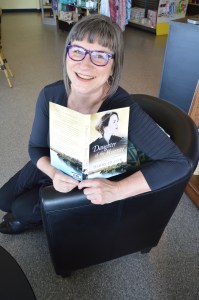
 My stories are not voices so much as pictures in my head, moving pictures. Characters are formed on a twist of a brow or a turn of a hand. Sometimes the first thing to come along will be a character’s name. Always the two words that follow are ‘What if?’

 Hi Jennifer, and thanks for having me visit.
 2015 vintage. The picking was hard work as the Grenache bushes are low to the ground. But a good grape stomping followed by a delicious breakfast (including some of the lovely wine) made it all worthwhile.
 The old Port Willunga Jetty has so much history and the famous Star of Greece restaurant perches on the cliff above, named for the ship that was wrecked only one hundred metres offshore in 1888, now a popular dive site. The rapidly crumbling jetty and the storage caves dug into the cliffs make it one of the most photographed places in South Australia. The area and the jetty get a mention in the McLaren Vale novels too.
 Much of the coastline is a sanctuary, particularly the Aldinga Reef area. The birdlife is abundant and kites can often be seen soaring along the golden limestone cliffs looking for prey. Dolphin pods are a regular sight and the area is also a haven for shingleback lizards (otherwise known as Sleepy Lizards) as well as several species of protected flora.
 thousand miles away once you’re there. You can feel the stresses of the city just falling away when you turn the corner and see the turquoise waters of the Spencer Gulf stretching out before you.
 Hi, and thanks for having me visit, Jennifer.


 “To their right, a high ceiling of honeycombed grey rock rimmed the edge of the clearing. A pile of tumbled rocks rose in what looked to be a manmade cairn where the grey rock met the ground. High above them at least a dozen snakes hung from the intertwined branches. As she watched, the milky, bulbous eyes of a striped green snake looked back at Emlyn and she suppressed a shiver. A soft noise came from in front of them and the boys walked over to the rock cairn. All three of them looked up. A large gap in the green canopy revealed a triangle of midnight-blue clear sky. The noise became louder, and suddenly, with a huge whooshing sound, the space filled with dozens and then hundreds of small black bats as they flapped up to the open space and disappeared into the dusk.

 in history. From Henry Handel Richardson’s (yes she’s a woman) Fortunes Of Richard Mahoney, Nancy Cato’s All The Rivers Run through to Colleen McCullough’s Thorn Birds, the drama, difficulties and romance of the bush has long been the stuff of great narrative tales. And the tradition continues!
 It’s been a worrying time, with bushfires threatening our farm beside the Bunyip State Forest.. We had to evacuate, horses included, but are now home, and trying to get back to normal. So I’m pleased to belatedly announce that Journey’s End is available internationally. Here’s a Q&A with editor Kathryn Ledson about the book.


 As you might guess Kath, the romance with the animals and nature came most easily. Followed closely by the love between the animals and the two children. I completely understand that intense childhood connection with the natural world. Because, as I said before, I never outgrew it.
 A Happy New Year to all my friends and readers! It’s a beautiful sunny New Year’s Day here in the southern Victorian ranges – one of the loveliest places on earth. I’m looking forward to a wonderful year full of riding, writing and reading.